

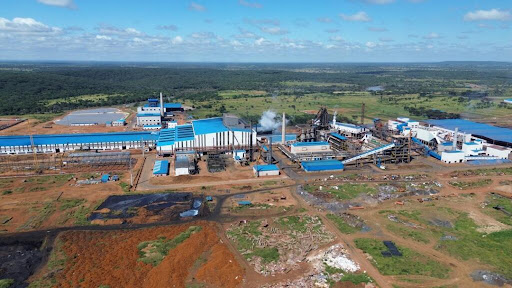
The operationalisation of the Dinson Iron and Steel Company (DISCO) plant at Manhize marks the most consequential industrial development in Zimbabwe since the collapse of ZISCO in the late 1990s. As a cornerstone of the US$1.5 billion Chinese-backed integrated steel complex, Manhize represents more than the revival of steelmaking — it signals a fundamental restructuring of Zimbabwe’s economic trajectory, geopolitical alignment, and industrial sovereignty.
Its significance is not merely industrial, but systemic. Manhize sits at the intersection of industrial policy, regional trade, foreign investment strategy, social legitimacy, and national autonomy. It therefore demands analysis not only as a factory, but as a political-economic institution with long-term consequences.
- The Catalyst for National Re-industrialisation
Economically, Manhize is a structural intervention into Zimbabwe’s chronic deindustrialisation.
Generating nearly US$100 million in sales in H1 2025, the plant directly mitigates the country’s historic dependency on imported steel — a dependency that has drained foreign currency, inflated infrastructure costs, and hollowed out domestic manufacturing. Steel is not merely another commodity; it is a strategic input into transport, energy, water, housing, and industrial machinery. Its domestic availability lowers costs across the entire economy and raises the viability of infrastructure-led development.
This makes Manhize central to the logic of Vision 2030 not rhetorically, but materially. It restores Zimbabwe’s capacity to build, not just to extract or consume.
The linkages are especially critical:
- Public infrastructure projects such as the Lake Gwayi-Shangani Dam, roads, power plants, and housing can now source domestically.
- This internalises value previously exported through imports.
- It creates demand certainty for steel production while providing price stability for public investment.
The Special Economic Zone (SEZ) designation further amplifies this catalytic potential. If properly governed, it can incubate downstream industries — rolling mills, fabrication, construction materials, automotive components, agricultural equipment, and eventually machinery manufacturing. This is how industrialisation becomes self-reinforcing rather than extractive.
The employment narrative is equally powerful. The promise of 25,000 direct and 150,000 indirect jobs represents not just labour absorption but skills formation, technological learning, and the reconstitution of an industrial working class — something Zimbabwe has steadily lost over two decades of economic contraction.
In this sense, Manhize is not simply an industrial asset; it is a social and institutional rebuilding mechanism.
- A Strategic Reorientation of Regional Steel Dynamics
Regionally, Manhize represents a shock to the Southern African steel ecosystem.
Zimbabwe has historically been a marginal player in SADC industrial trade. With Manhize exporting pig iron and billets to South Africa, that position is already changing. At its ultimate capacity of 5 million tonnes annually, DISCO could emerge as the region’s lowest-cost bulk steel supplier — reshaping price structures, sourcing strategies, and industrial geography.
This challenges South Africa’s historic dominance in steel and metals processing. It introduces:
- New competition for South African producers;
- Alternative sourcing for regional infrastructure projects;
- The possibility of Zimbabwe becoming a materials hub for Southern Africa.
This is not merely economic — it is geopolitical. Industrial capacity is power. Steel underpins infrastructure, defense, energy, and transport. A Zimbabwe that supplies steel to the region gains strategic relevance, bargaining power, and regional centrality.
Moreover, Manhize anchors China’s Belt and Road strategy physically in Southern Africa — not through ports or finance alone, but through productive capacity. It embeds Chinese industrial capital into African value chains rather than just extractive flows, marking a subtle shift in China–Africa relations from commodity extraction to industrial platform-building.
This could be beneficial — or binding — depending on governance.
- The Inescapable Shadows: Sovereignty, Sustainability, and Social Legitimacy
Yet the very scale that makes Manhize transformative also makes it risky.
Ownership by Tsingshan Holdings situates Zimbabwe within a foreign industrial strategy over which it has limited influence. This raises classic questions:
- Who controls pricing?
- Where are profits repatriated?
- Who controls technology, data, and industrial decision-making?
Without deliberate policy, Zimbabwe risks becoming the location of industry without being its owner, architect, or ultimate beneficiary.
The resources-for-infrastructure dynamic, while pragmatic, is structurally asymmetrical. Capital, technology, and management are imported; raw materials, land, labour, and environmental externalities are domestic. If left unmanaged, this can reproduce dependency rather than eliminate it.
Environmental and social concerns intensify this risk. Steel is among the most environmentally intensive industries:
- High energy consumption
- Significant carbon emissions
- Water usage and pollution risks
- Land displacement and ecological footprint
The land rights and resettlement grievances raised by civil society are therefore not side issues — they are indicators of institutional weakness. Social legitimacy is as critical to industrial sustainability as technical efficiency. A plant that generates social conflict undermines its own long-term viability.
Finally, the reported shutdowns for maintenance and upgrades reveal vulnerability. Zimbabwe is effectively tying a large portion of its industrial future to the operational health and global market position of one foreign firm. This concentrates risk and reduces national resilience.
Conclusion: A High-Stakes Foundation
Manhize is not a normal investment. It is a structural bet on a new development path.
It offers Zimbabwe:
- A credible reindustrialisation platform;
- Regional economic relevance;
- A reversal of import dependence;
- A chance to rebuild industrial skills and institutions.
But it also introduces:
- Strategic dependency on foreign capital and governance;
- Social and environmental risks;
- The danger of enclave industrialisation disconnected from the domestic economy.
Whether Manhize becomes a foundation for sovereignty or a pillar of dependency will depend not on output volumes, but on governance quality.
The state must therefore move decisively from host to strategic partner and regulator. This means:
- Maximising domestic linkages: Ensuring downstream industries, procurement, and local suppliers are structurally integrated.
- Institutionalising social accountability: Transparent, enforceable mechanisms for land, labour, and environmental justice.
- Safeguarding sovereignty: Mandating skills transfer, local ownership participation, technology sharing, and fair taxation.
Manhize has lit the industrial furnace. But steel does not forge itself.
The question is no longer whether Zimbabwe can industrialise — but whether it can govern industrialisation well enough to ensure that the heat strengthens the nation rather than burn it.
The fire is lit. The forge is ready. What remains is the craft.